

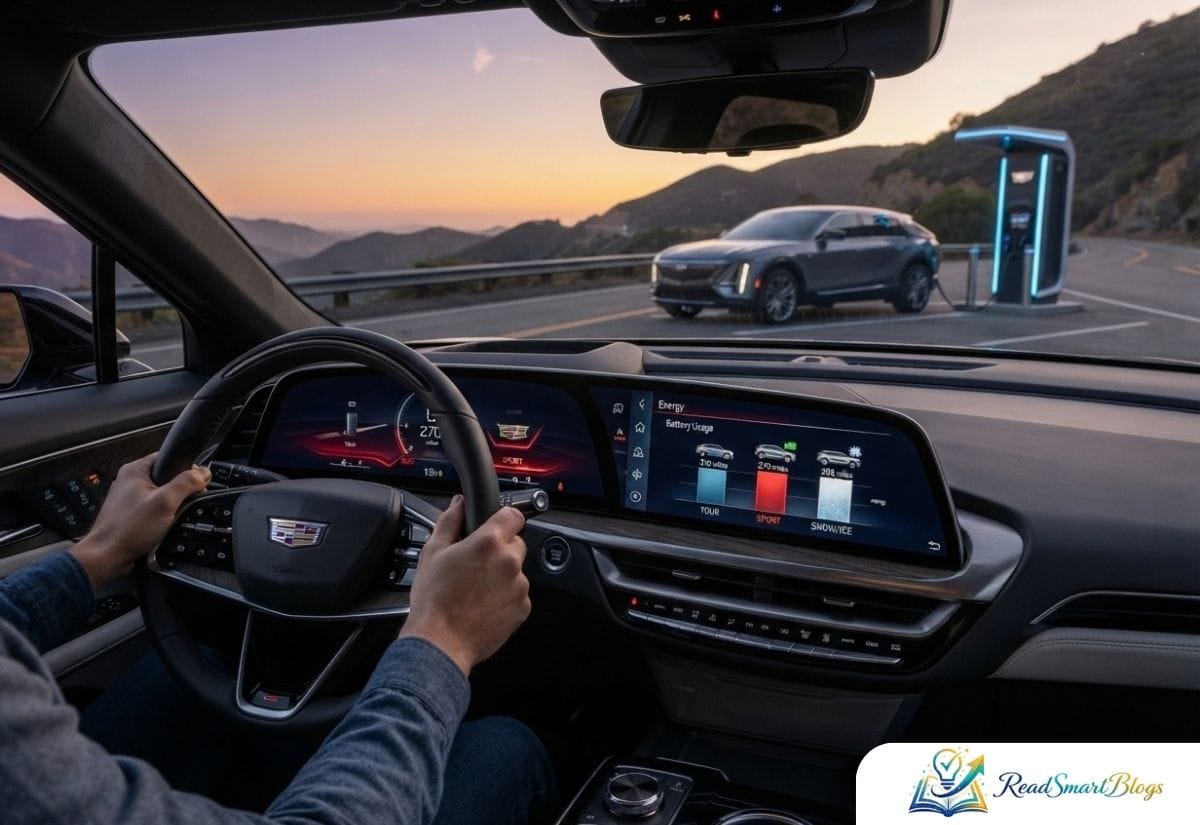
The Cadillac LYRIQ gives drivers several ways to change how the SUV responds on the road. Tour, Sport, Snow/Ice, and My Mode are designed for different driving situations and preferences. This naturally raises an important question: do the driving modes in Cadillac LYRIQ offer different ranges or battery usages?
The short answer is that changing the driving mode does not change the physical capacity of the LYRIQ battery. Instead, the selected mode changes vehicle responses such as accelerator feel, torque response, steering, braking, or other driving characteristics. Those changes can affect how much energy the vehicle uses in real-world driving, especially when a particular mode encourages stronger acceleration.
Cadillac also notes that actual range can vary with conditions such as temperature, terrain, battery age, loading, use, and maintenance. Therefore, the driving mode is only one part of the overall range picture.
In This Article
How the Cadillac LYRIQ Driving Modes Work
The LYRIQ uses its drive modes to adapt the driving experience to everyday roads, slippery conditions, or a driver’s preferred settings. Cadillac lists four relevant modes for LYRIQ: Tour, Snow/Ice, Sport, and My Mode.
These modes do not function like different battery sizes. Instead, they alter the vehicle’s behavior.
For example, Tour is intended for everyday driving and provides a smooth driving experience. Sport gives the LYRIQ a more immediate torque response and a stronger feeling of road connection. Snow/Ice is designed to help reduce wheel spin on slippery surfaces, while My Mode lets the driver personalize several characteristics of the vehicle.

Tour Mode
Tour is the predominant everyday mode for the LYRIQ. Cadillac describes it as being tuned for a smooth ride and normal daily driving.
For drivers interested in efficiency, Tour is generally the most straightforward setting because it does not encourage a sport-focused driving response. Smooth acceleration and steady speeds can help reduce unnecessary energy consumption.
However, selecting Tour does not guarantee a specific range. A driver traveling at high highway speeds in Tour can still use considerably more energy than another driver moving at moderate speeds.
Sport Mode
Sport mode is designed to make the LYRIQ feel more responsive. Cadillac describes it as providing a more immediate torque response and an enhanced feeling of road connection.
That response can make stronger acceleration easier and more appealing. If the driver frequently uses the available performance, energy consumption can increase.
This does not mean that Sport mode automatically removes a fixed number of miles from the estimated range. The actual effect depends on how the vehicle is driven.
Snow/Ice Mode
Snow/Ice mode is intended for slippery conditions. It changes the accelerator and torque response to help reduce wheel spin and improve control.
In this situation, the road conditions themselves may have a greater effect on range than the selected mode. Cold temperatures, snow, wet roads, tire conditions, and slower traffic can all influence energy consumption.
Therefore, Snow/Ice should be viewed primarily as a traction-oriented mode rather than a range-maximizing setting.
My Mode
My Mode gives the driver more control over the character of the LYRIQ. Depending on the available settings, the driver can personalize accelerator responsiveness, steering feel, braking responsiveness, and Electric Vehicle Sound Enhancement.
Because the settings can be customized, its energy effect depends on how the driver configures and uses the vehicle.
Do LYRIQ Driving Modes Actually Change Battery Range?
The most important distinction is between battery capacity and energy consumption.
Selecting a different driving mode does not turn a particular battery into a smaller or larger battery. The battery’s physical capacity remains the same.
What can change is how the vehicle uses that stored energy. A mode that produces a more responsive accelerator or encourages more aggressive acceleration can lead to greater electricity consumption during real-world driving.
The estimated range shown by the vehicle can also change because range is an estimate rather than a fixed promise. Cadillac states that actual driving range varies according to several conditions.
Does the Battery Capacity Change?
No. The battery capacity does not become larger or smaller simply because the driver selects Tour, Sport, Snow/Ice, or My Mode.
For example, Cadillac’s 2024 LYRIQ specifications list a 102-kWh battery system for the referenced configuration. The same specification document explains that actual range varies depending on factors including temperature, terrain, battery age, loading, use, and maintenance.
The important point is that battery capacity and driving range are not the same thing.
Battery capacity describes how much electrical energy can be stored. Range describes how far the vehicle can travel using that energy under particular conditions.
Can Different Modes Use More or Less Energy?
Yes, indirectly.
A driving mode can change the vehicle’s response, and that can influence driving behavior. Sport mode, for instance, provides a more immediate torque response. If the driver repeatedly uses strong acceleration, energy consumption can rise.
Tour mode may encourage smoother everyday driving, while Snow/Ice changes acceleration and torque response to help maintain traction.
Still, there is no universal mileage difference that applies to every driver. The selected mode is only one variable among many.
Why the Estimated Range May Change
An EV’s displayed range is an estimate based on expected energy consumption and available battery energy.
If recent driving becomes less efficient, the estimated remaining range can fall faster. If conditions become more efficient, the estimate can behave differently.
This is why two LYRIQ vehicles with similar battery charge levels can show different projected ranges after being driven in different conditions.
How Each LYRIQ Driving Mode Can Affect Energy Usage
The relationship between drive mode and energy consumption becomes clearer when each setting is considered separately.
Tour Mode and Battery Efficiency
Tour is the natural choice for routine driving because it is designed around a smooth, comfortable driving response. Cadillac also describes Tour/Normal as an economical everyday setting in its general driver-mode guidance.
That does not mean Tour creates extra battery capacity. Instead, its predictable response can support smooth driving, which may help efficiency.
Sport Mode and Battery Consumption
Sport mode can use more energy in practice when the driver takes advantage of its quicker response.
Hard acceleration requires substantial electrical power. Repeated acceleration from low speeds can therefore have a noticeable effect on consumption.
The important distinction is that Sport mode itself should not be treated as having a fixed battery penalty. Driving style remains a major part of the result.
Snow/Ice Mode and Energy Use
Snow/Ice mode is designed around traction. Cadillac says the mode adjusts the pedal map to slow acceleration and torque response and help prevent wheel slip.
When winter conditions are present, however, the weather can have a substantial influence on range. Cold temperatures and slippery surfaces can make real-world energy consumption different from what a driver sees in mild conditions.
My Mode and Energy Consumption
My Mode depends on the settings chosen by the driver.
A configuration focused on a calmer accelerator response can support smooth driving. A more responsive configuration can make stronger acceleration easier.
Consequently, My Mode does not have one universal efficiency result.
Which Factors Affect Cadillac LYRIQ Range More Than Driving Mode?
Driving mode is only part of the equation. Several other factors can have a major effect on how far an electric SUV travels on a charge.
Highway Speed
High-speed driving can require considerably more energy because aerodynamic resistance increases as speed rises.
This means a LYRIQ driven at a steady moderate speed can have a very different consumption pattern from one driven at sustained high highway speeds.
City Driving and Stop-and-Go Traffic
City driving has both advantages and disadvantages for an EV.
Frequent stops can require repeated acceleration, but regenerative braking can recover some energy during deceleration. The result depends heavily on traffic, acceleration habits, road conditions, and how the driver uses regenerative features.
Driving Style and Acceleration
Driving style is one of the easiest variables for a driver to control.
Smooth acceleration, anticipating traffic, and avoiding unnecessary high-speed bursts can help reduce energy consumption. Aggressive acceleration generally requires more electrical power.
Regenerative Braking and One-Pedal Driving
The LYRIQ includes regenerative braking features, including One-Pedal Driving and Regen on Demand. Cadillac explains that One-Pedal Driving can provide different levels of deceleration and that regenerative braking can help capture energy during deceleration.
Regeneration does not recover all of the energy used for acceleration, but it can improve overall energy management.
Cadillac also advises that One-Pedal Driving is not recommended on slippery roads and that the brake pedal should still be used when immediate stopping is required.
Wheel and Tire Size
Tires have a direct connection to rolling resistance and vehicle efficiency. Different wheel and tire configurations can therefore contribute to different real-world consumption.
This is one reason why a published range figure should not be interpreted as a guarantee for every configuration or driving situation.
Outside Temperature
Temperature can have a significant effect on EV range.
The 2024 LYRIQ specifications specifically state that actual range varies with temperature and other operating conditions.
Cold weather can be particularly important because the vehicle may need additional energy for cabin heating and battery temperature management.
Heating and Air Conditioning
Climate control also consumes electrical energy.
On a cold day, heating the cabin can increase energy consumption. On a hot day, air conditioning can do the same.
For long trips, careful use of climate settings can therefore make a difference.
Terrain and Elevation
Going uphill requires additional energy because the vehicle is gaining elevation.
Downhill travel can allow regenerative braking to recover some energy, although it does not completely eliminate the energy required to climb.
Cadillac identifies terrain as one of the factors that can affect the actual range of the LYRIQ.
Cadillac LYRIQ Range in Different Driving Conditions
The cadillac lyriq range should be viewed as a condition-dependent figure rather than a guaranteed distance.
City Driving vs. Highway Driving
City and highway driving can produce different efficiency results.
In urban conditions, lower speeds may reduce aerodynamic losses, while frequent acceleration and braking can increase consumption. Regenerative braking can recover some energy during deceleration.
On highways, steady driving can be smooth, but higher speeds can increase aerodynamic energy requirements.
The exact result depends on the route and driving style.
Summer vs. Winter Range
Temperature is particularly important for electric vehicles.
A mild day may produce a different result from a very cold or very hot day. Cabin heating, cooling, road conditions, and battery temperature can all contribute to the difference.
For that reason, a driver should not assume that the official range figure will remain identical throughout the year.
Why Does the Cadillac LYRIQ Lose Range in Winter?
Winter range changes can result from several factors rather than one specific cause.
Cold temperatures can affect battery performance, while cabin heating requires additional energy. Snow and wet roads can also increase resistance, and winter tires may have different rolling characteristics.
The 2024 specifications explicitly warn that actual range varies according to temperature and other conditions.
How to Get the Most Range Out of a LYRIQ
A driver looking to maximize range can focus on controllable habits rather than relying only on a particular drive mode.
Smooth acceleration is useful because repeated hard launches consume substantial energy. Maintaining sensible speeds can also reduce aerodynamic losses.
Regenerative braking can help recover energy during deceleration. Cadillac provides both One-Pedal Driving and Regen on Demand on the LYRIQ.
Charging habits also matter. Cadillac recommends charging to about 80% for daily use, while allowing a higher charge level when additional range is needed for longer journeys.
Route planning can also make long-distance driving easier. Cadillac’s current LYRIQ information describes route planning that can show estimated battery level at arrival and includes Fast Charge Prep when supported.
Cadillac LYRIQ Battery, Range and Charging Explained
The LYRIQ uses an Ultium-based battery system. Cadillac’s specifications for the 2024 model list a 102-kWh battery system, while the manufacturer’s current LYRIQ specifications also identify a 102-kWh battery capacity.
Range varies by model, drivetrain, configuration, and conditions. For example, Cadillac’s current specifications list up to 326 EPA-estimated miles for certain single-motor RWD versions and up to 319 miles for certain dual-motor AWD versions.
These figures demonstrate why battery capacity alone does not determine range. Drivetrain and vehicle configuration matter too.
How Long Does the LYRIQ Battery Last?
Battery life and driving range are different questions.
Driving range refers to the distance available from a particular charge. Battery life refers to how the battery performs over a much longer period of ownership.
Charging practices, temperature exposure, usage, and other operating conditions can influence long-term battery performance. Cadillac recommends an approximately 80% daily charging level and a higher charge for longer trips.
2024 Cadillac LYRIQ: What Owners Should Know
The 2024 Cadillac LYRIQ is an important model year for buyers researching the vehicle’s early configurations and technology.
The 2024 specifications list a 102-kWh battery system and a GM-estimated driving range of up to 530 km for the specified configuration in that document. The same document emphasizes that actual range varies according to conditions.
2024 Cadillac LYRIQ Driving Modes
The 2024 model includes a Driver Mode Selector, along with regenerative braking features. Cadillac’s 2024 trim information lists the Driver Mode Selector as standard across the referenced Tech, Luxury, and Sport trims.
The exact driving experience can depend on configuration and equipment.
2024 Cadillac LYRIQ Range
The range should be considered alongside temperature, terrain, battery condition, load, maintenance, and driving behavior rather than as one fixed real-world number.
Cadillac LYRIQ Models and Range Considerations
Different model years and powertrain configurations can have different specifications, so buyers should check the exact vehicle rather than assuming every LYRIQ has identical range.
The 2025 Cadillac LYRIQ, 2026 Cadillac LYRIQ, and earlier model years can differ in available configurations and specifications.
A 2023 Cadillac LYRIQ can also be relevant to used-vehicle shoppers who are comparing earlier versions with newer model years.
The same principle applies to a used Cadillac LYRIQ: the exact trim, drivetrain, battery condition, mileage, equipment, and model year should be checked before comparing range.
Cadillac LYRIQ V
The LYRIQ family also includes higher-performance variants such as the LYRIQ-V. Cadillac lists different performance and range specifications for the LYRIQ-V, so its figures should not automatically be applied to a standard LYRIQ.
Cadillac LYRIQ Price, Lease and Buying Considerations
For shoppers researching cadillac lyriq price, range is only one part of the purchasing decision. Trim level, drivetrain, equipment, incentives, and model year can all affect the overall cost.
A cadillac lyriq lease can also have different terms from a traditional purchase, so the monthly payment should not be treated as the vehicle’s total cost.
People searching for a cadillac lyriq for sale should check the exact model year and configuration before comparing specifications.
The same applies to someone searching for a used Cadillac LYRIQ for sale. Battery condition, mileage, charging history, warranty coverage, and equipment can be important considerations.
Searches such as cadillac lyriq lease deals, cadillac lyriq used, and cadillac lyriq for sale near me can involve constantly changing listings and pricing, so current dealer or marketplace information should be checked separately.
The cadillac lyriq interior is another consideration for buyers, but it does not determine the central question of whether driving modes change battery capacity.
A general cadillac lyriq review can provide broader information, but range comparisons should always be tied to the exact model and test conditions.
Frequently Asked Questions About Cadillac LYRIQ Driving Modes
Do the driving modes in Cadillac LYRIQ offer different ranges or battery usage?
The modes do not change the physical battery capacity. However, they can influence vehicle response and driver behavior, which can affect real-world electricity consumption and estimated range.
Which Cadillac LYRIQ driving mode is best for range?
Tour is designed for everyday driving and is the most straightforward mode for drivers prioritizing a smooth, predictable driving experience. Actual range still depends heavily on speed, temperature, terrain, traffic, and driving style.
Does Sport Mode use more battery?
It can in real-world use when its more immediate response leads to stronger or more frequent acceleration. Cadillac does not establish a universal percentage of range lost simply from selecting Sport mode.
Does Snow/Ice Mode reduce LYRIQ range?
Snow/Ice is designed to improve control on slippery surfaces by modifying acceleration and torque response. Any reduction in real-world range may also be influenced by the cold, snow, wet roads, tires, and other winter conditions.
Does Tour Mode improve LYRIQ efficiency?
Tour is the everyday driving mode and is intended to provide a smooth ride. It can support efficient driving when combined with moderate speeds and smooth acceleration, but it does not change the battery’s capacity.
Does My Mode affect battery consumption?
Potentially. My Mode allows the driver to customize characteristics such as accelerator responsiveness, steering feel, and braking responsiveness. The resulting energy consumption depends on the settings and driving behavior.
Does the LYRIQ battery capacity change between driving modes?
No. Selecting a different driving mode does not physically increase or decrease the battery’s capacity.
What affects Cadillac LYRIQ range the most?
Temperature, speed, terrain, vehicle configuration, battery condition, loading, climate control, and driving style can all affect range. Cadillac specifically identifies temperature, terrain, battery age, loading, use, and maintenance among the factors that can change actual range.
How can the LYRIQ get better battery efficiency?
Smooth acceleration, sensible speeds, effective use of regenerative braking, appropriate climate settings, proper tire maintenance, and thoughtful charging and route planning can all support efficient driving.
Final Answer: Do LYRIQ Driving Modes Change Range or Battery Usage?
The answer is yes and no, depending on what “change” means.
The driving modes do not change the physical battery capacity of the Cadillac LYRIQ. Tour, Sport, Snow/Ice, and My Mode instead alter aspects of the driving experience and vehicle response.
Those differences can indirectly affect energy consumption. Sport’s more immediate torque response may lead to higher consumption when the driver makes frequent hard accelerations. Tour supports a smoother everyday experience, while Snow/Ice prioritizes traction and My Mode allows personalized settings.
However, the driving mode is not the only factor. Speed, temperature, terrain, tires, climate control, regenerative braking, vehicle configuration, battery condition, and driving style can all influence the actual distance available from a charge.
So, when comparing LYRIQ range, the most useful approach is to look at the complete driving situation rather than treating the selected mode as a fixed range setting.










Leave a Reply